
Stay up-to-date on the latest news, trends and perspectives in media and philanthropy.

MIF Member Spotlight: Committee to Protect Journalists (CPJ)
For more than 40 years, the Committee to Protect Journalists (CPJ), has been at the forefront of defending journalists around the globe, ensuring they can report the truth safely and without fear of persecution. As attacks on the press continue to escalate—both internationally and here in the United States—journalists face mounting threats, including online harassment, physical violence, and legal and regulatory challenges. In this Q&A, we sit down with Jodie Ginsberg, CEO of the Committee to Protect Journalists, to explore the organization’s insights on the state of press freedom, the critical role of funding in supporting independent journalism, and the unique threats posed by a shifting political landscape in the U.S. and abroad. CPJ, which joined as a member of MIF in 2024, has also recently announced the Climate Crisis Journalist Protection Initiative, a $1 million effort to provide climate journalists with assistance, safety training, and other forms of support. This conversation comes at a pivotal moment, as the world grapples with the growing weaponization of distrust against the press and an urgent need to bolster the safety and resilience of journalists everywhere. Nina Sachdev, Director of Communications, Media Impact Funders: CPJ is an intermediary, and I think… Read More
January 29, 2025
–
- Nina Sachdev
Here’s what the MIF team is reading, watching and listening to these days
For our final newsletter of the year, I’ve asked my colleagues what kinds of media they’re into right now. The choices are endless these days, and I just need to know that there’s more to life than “Cobra Kai.” (I hope you all remember that this was the #1 streaming show during COVID lockdowns. And that’s all I’ll say about that.) As for me, I’m reading a captivating mystery by one of my favorite Philly-based authors, Liz Moore. “The God of the Woods,” which made NPR’s list of best books of 2024, follows the disappearance of a child from summer camp. As the search for her continues, a web of long-buried secrets and dark family histories unravels. If you like mystery and you have ties to Philly (or even if you don’t), you’ll love Moore’s “Long Bright River,” about two estranged sisters living in Kensington, a neighborhood ravaged by the opioid crisis. Even if you hate Philly, just remember: No one likes us; we don’t care. I’m also not even remotely embarrassed to admit that I’m watching a “Drunk History”-esque HBO series called “It’s Florida, Man,” which is the most delightful comedic dramatization of actual… Read More
December 16, 2024
–
- Nina Sachdev
Curating and Executing an Accessible Zoom Meeting: A Model for Accessibility
We recently hosted an online meeting about how funders can advance accessibility in media and film. Throughout the planning process, our team learned a lot about what it takes to produce a virtual event that is inclusive and accessible to all participants. Dig into the steps we took below—we hope this will serve as a blueprint for you when planning virtual events that foster meaningful engagement in the future. Costs: Excluding staff time and honoraria for speakers from non-member, non-grantmaking organizations, the costs for this session was $400. CART Services – $180.00 per hour of service ASL Interpretation – $140.00 per hour of service Pre-Production Ensuring Disability Representation: We prioritized disability representation among panelists to ensure diverse perspectives and lived experiences informed the session. Timeline For most of our programs, we typically follow a 4–8 week timeline for organizing an online session. However, for this program, we chose to postpone it several times to ensure we had the necessary time and space to execute it thoughtfully. Following best practices, we prioritized a deliberate pace of four months to ensure all elements were properly addressed, no one felt rushed, and both panelists and attendees had ample time to understand and prepare… Read More
December 10, 2024
–
- Roshni Melia
MIF is hiring an Executive Director
Position: Executive Director Location: Flexible in the U.S., with up to 33% estimated travel (U.S. and international) Reporting relationship: Board of Directors ABOUT MEDIA IMPACT FUNDERS Media Impact Funders (MIF) traces its roots back to the Council on Foundations, a longtime philanthropy-serving organization. Formerly Grantmakers in Film, Video & Television, MIF began on a volunteer basis in 1984 as an affinity group for funders interested in the power of film to highlight social issues. Reflecting changes in technology and media behavior over the subsequent decade, it was renamed Grantmakers in Film & Electronic Media (GFEM) and formally incorporated in 2008 to advance the field of media arts and public interest media funding. It had 45 members and was headed by former MacArthur Foundation Program Officer Alyce Myatt. GFEM was renamed Media Impact Funders in 2012 and has since expanded its strategy to include a broad range media funding interests such as journalism, immersive technologies, media policy and more. Since that time, MIF has grown to more than 120 organizational members representing some of the largest foundations and holds more than 40 in-person and online events yearly. Today, MIF represents changemakers in the media funding space, serving a… Read More
December 5, 2024
–
- Media Impact Funders
WATCH: Access Matters: Funders Role in Advancing Accessibility in Media and Film
We explored the current state of disability representation in media and why it is crucial to address the persistent lack of inclusivity and support for people with disabilities. This representation matters because it shapes public perception and opportunities, yet individuals with disabilities often face barriers to equitable participation and portrayal. The panelists provided actionable insights into how the funding community can play a pivotal role in promoting accessibility initiatives across the industry. From supporting career development for filmmakers with disabilities, championing accessible production practices, covering physical accessibility for in-person exhibitions like festivals and theaters and funding accessibility assets for media that is made. This session offered a comprehensive look at the various ways funders can drive positive change. Watch the compelling discussion that explores the need for funders to advance accessibility in media and film. We heard from: Cassidy Dimon, Executive Director, FWD-Doc Keisha Knight, Director, IDA Funds and Advocacy, International Documentary Association Richie Seigel, Co-Founder & President, Inevitable Foundation Carrie Lozano, President and CEO, ITVS (moderator) Resources shared during the Session: https://www.fwd-doc.org/toolkit https://www.indievisibleentertainment.com/production-accessibility-coordinators https://www.fullspectrumfeatures.com/access-reframed Scorecard Impact Report: https://www.fwd-doc.org/accessibility-scorecard-impact-report-2023 Here is the report that states that 1 penny of every 10 dollars foes to… Read More
December 5, 2024
Journalism’s Threatened Role in Our Democracy
Catherine Devine (Rita Allen Foundation Civic Science Fellow 2024-25) shares reflections from the 2024 JFunders annual meeting in San Francisco: My first encounter with journalism was with my town’s Hometown Weekly—a modest paper that covered everything from local elections to dance recitals, graduations to high school football games. It was only recently, at the JFunders annual gathering at KQED’s headquarters in San Francisco, that I began to reflect on the role that little paper played in my life. Growing up, I didn’t know it, but the Hometown Weekly was like a quiet thread running through Dover, Massachusetts, weaving us together in subtle, necessary ways. It gave neighbors a reason to cheer on the local graduates, it handed a slice of fame to the high school all-stars, and in its own way, it held us—our community—steady, even if I was too young to recognize it. There’s something undeniably powerful in that, a reminder of what local journalism can offer when it’s done right: a small, constant current that flows through a place, letting people feel seen, understood, and connected. During the JFunders gathering, Snap Judgment founder Glynn Washington spoke about empathy as the backbone of good journalism. “Storytelling isn’t about convincing,” he said. Read More
November 21, 2024
Safeguarding Media & Journalism Meeting Notes
This is members-only content. Please log in to view.
November 13, 2024
–
- Media Impact Funders
How funders can navigate election anxiety—and prepare for what’s next
Angelica Das is an associate director on the Public Square Team at Democracy Fund. Last month, during our annual journalism funders gathering, Angelica led a discussion about how funders are supporting each other, their staff and their grantees at a time of intense anxiety around the election.
If you’re feeling election anxiety, you’re not alone. The source of anxiety is unique to each of us: local vs. national election outcomes, navigating a deluge of mis- and disinformation, recovery from natural disasters, economic stress, or fear of physical and digital threats and harm. Read More
November 4, 2024
Highlights from JFunders24: Day 2
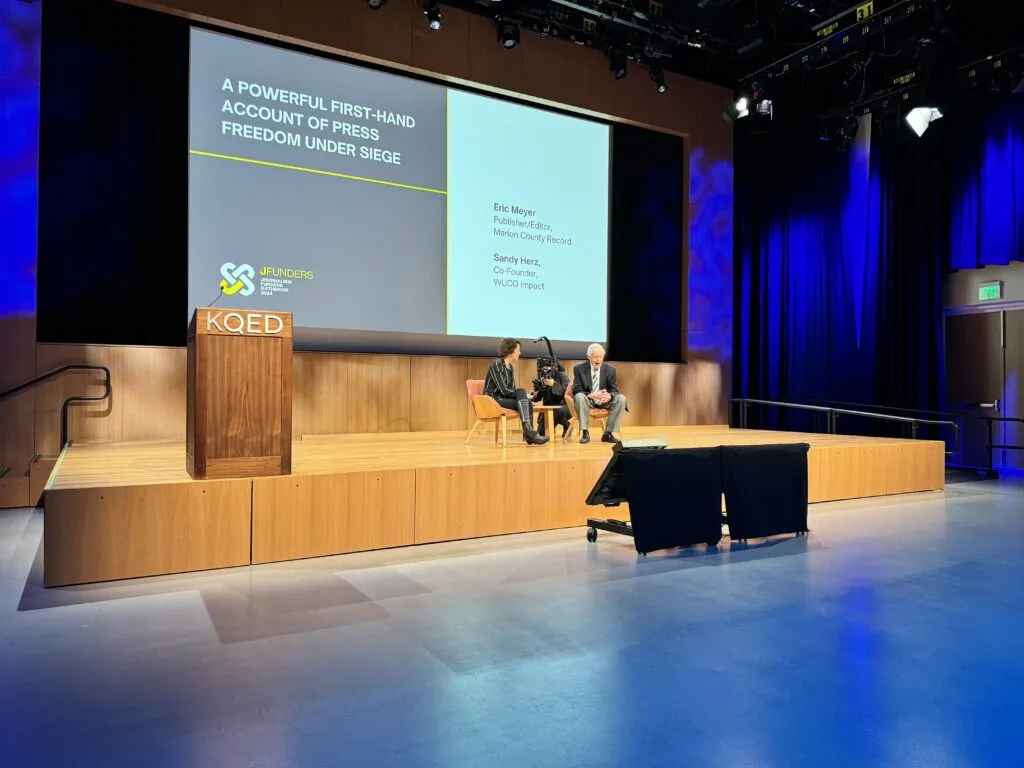
Day 2 of JFunders24 was focused on funder-only discussions, some meant to expand funders’ understanding of journalism grantmaking—such as a session unpacking the mechanics of for-profit grantmaking—and others that were meant to explore opportunities for support in areas such as legal threats, digital and physical safety and security, the backlash against racial equity, and more. But before we kicked off those conversations, we heard a few mainstage presentations about solutions to paywalls, policy action benefiting community and ethnic media in San Francisco, tech platforms enabling more authentic storytelling, and how data uncovered hidden narratives for Black Californians. We also heard this unbelievably powerful story: In August 2023, the Marion County Record, a small Kansas newspaper, made national headlines after a controversial police raid in which authorities seized newsroom equipment and documents from the office and homes of Publisher Eric Meyer and his mother, co-owner Joan Meyer. Shocked by the invasion, Joan died the next day. While the paper was cleared of wrongdoing, the raid prompted widespread criticism as an attack on press freedom. On the morning of Day 2, we heard this powerful account first-hand from Eric, in conversation with Sandy Herz,… Read More
November 4, 2024
–
- Media Impact Funders

Highlights from JFunders24: Day 1
At a time when pillars of American journalism such as The Washington Post and The Los Angeles Times are crumbling at the hands of their billionaire owners, leading lights of journalism and philanthropy came together last week for the annual gathering of journalism funders at public media bulwark KQED in San Francisco to explore how best to strengthen public interest journalism. Convened by Media Impact Funders, JFunders24 brought together leading journalism funders from around the country for two days of presentations and discussions with journalists, media executives, academic scholars, political figures and policy experts. We covered a wide range of urgent topics, including frank and practical conversations about mergers and acquisitions, the myriad implications of artificial intelligence and the urgency of addressing the balance of power in journalism and storytelling. Our first day of programming began with an all-star panel of media leaders from PRX, KERA and the Center for Investigative Reporting, as they navigate the challenging passage through mergers and acquisitions, with expert moderation by MIF board chair Kayce Ataiyero, Chief External Affairs Officer at The Joyce Foundation. Then, California State Sen. Steve Glazer spoke with Rebuild Local News board… Read More
October 31, 2024
–
- Vincent Stehle
MIF Member Spotlight: The Schmidt Family Foundation
Since 2006, the Schmidt Family Foundation, established by Eric and Wendy Schmidt, has been at the forefront of supporting climate change communication initiatives. Wendy Schmidt, with her background in journalism, recognized the critical role of clear and accurate information in driving meaningful action. One of the Foundation’s key priorities has been to bridge the gap between complex scientific data and accessible public understanding. After extensive discussions with climate experts and scientists, Wendy was drawn to a groundbreaking idea: the creation of a “bridge” institution that could provide the media with independent, reliable and credible scientific information on climate change. This commitment led to the founding of Climate Central, a nonpartisan organization dedicated to empowering journalists and the public with accurate and accessible climate data. Here, we sit down with Joe Sciortino, the Foundation’s executive director, to explore Schmidt’s approach to media grantmaking, the gaps and opportunities in the field of media funding, and the urgent need for more climate media storytelling. Nina Sachdev, Director of Communications, Media Impact Funders: Let’s talk about the evolution of Schmidt’s media grantmaking strategy. What are some of the major takeaways and insights from supporting this kind of work for nearly… Read More
August 28, 2024
–
- Nina Sachdev
WATCH: From Stories to Solutions: Media’s Role in Philanthropy
Facing significant challenges, local news outlets are providing less coverage of crucial topics—including philanthropy. This decline often obscures philanthropy’s vital role in keeping communities vibrant and meeting critical needs. To address this, The Chronicle of Philanthropy’s Nonprofit Accountability and Solutions Fellowship equips local journalists with the skills needed to craft compelling stories about the vital work of nonprofits and foundations. Research shows a strong public desire for information on how communities tackle problems, and nonprofits often play a central role as connectors and problem solvers. That role is especially crucial as America faces growing divides. To spotlight how philanthropy is working to bring people together to build civic connections, The Chronicle just launched a new project, called the Commons, which offers reporting, opinion, essays, resources, tools and more. Media philanthropy, in particular, can contribute significantly by investing in a diverse range of narratives from various communities. Watch this compelling discussion that explores the critical role of storytelling in philanthropy. Speakers: Steve Kilar, Equity Issues Editor, Arizona Republic Stacy Palmer, CEO, The Chronicle of Philanthropy Andrew Simon, Editor-in-Chief, The Chronicle of Philanthropy Fay Twersky, President and Director; The Arthur M. Blank Family Foundation Vince Stehle, Executive Director, Media… Read More
August 28, 2024